
What House Flippers Know About Hiring Painters (That Most Homeowners Don't)
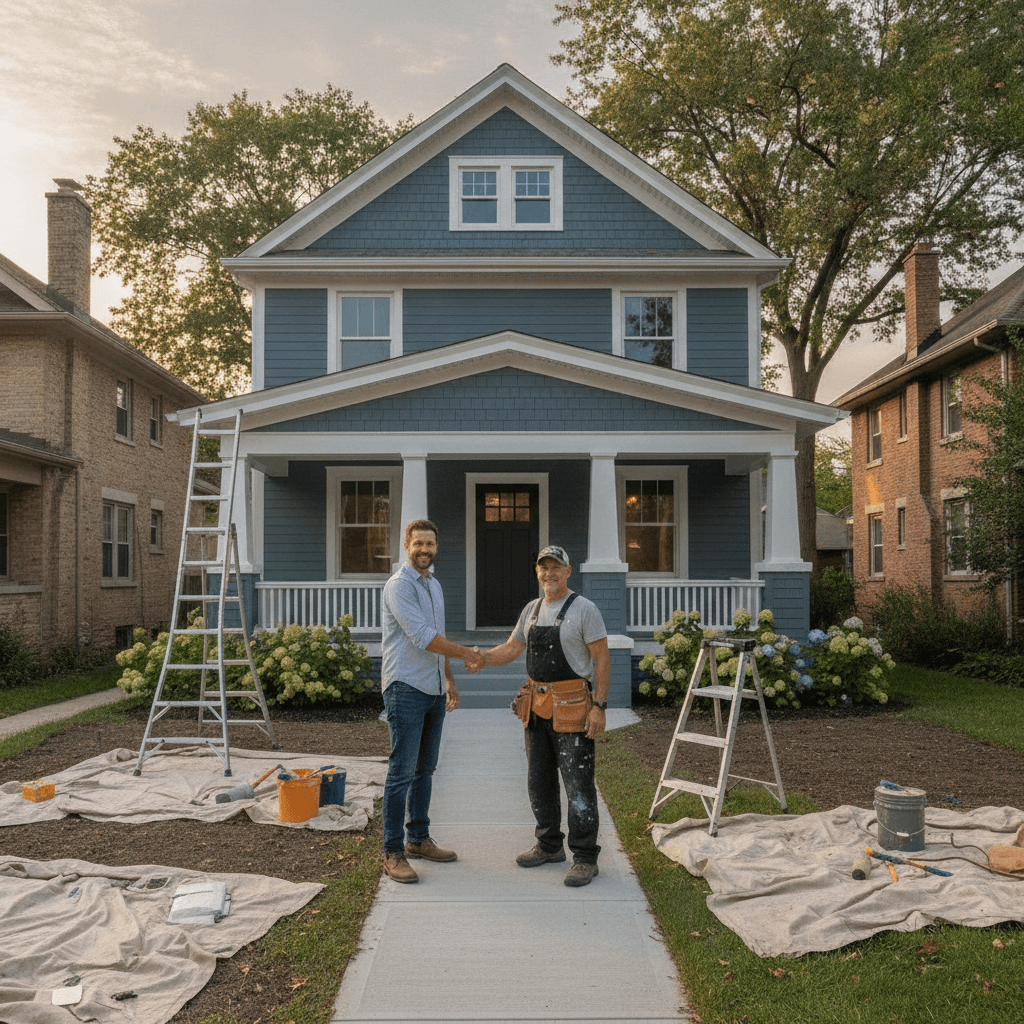
Before I ran a painting company, I hired them. A lot of them.
I grew up in my father's carpet cleaning business and have been in home services my whole life — a restoration business, a carpet cleaning business, and for years a house-flipping business around the northwest suburbs, where nearly every project needed paint: full interiors, exteriors, kitchens' worth of cabinets. When you're hiring painters with your own money and your own profit on the line, project after project, you get an education in the trade that most homeowners never get, because most homeowners hire a painter once every seven years.
Eventually I stopped searching and built the crew I could never find — that's Level Best (here's who I am). But this post isn't a pitch. It's the checklist I wish someone had handed me at flip number one. Use it on us, use it on anyone.
1. The quote tells you more than the price does
A painting quote is a preview of how the painter thinks. What I learned to look for:
Specific prep, in writing. "Paint exterior" is not a scope. "Wash, scrape and sand failing areas, spot-prime bare wood, re-caulk joints, two coats" is a scope. Painters who itemize prep do prep. Painters who write one-line quotes are leaving themselves room, and that room is where quality goes to die.
Named products. Not "premium paint" — the actual brand and line. There's a real difference between a manufacturer's contractor-grade and top-shelf lines, and vague quotes usually mean the cheap one.
Coat count in writing. Two coats should be explicit. "Coverage as needed" means one coat wherever they can get away with it.
The lowball quote isn't cheaper — it's the same money spread across fewer steps. I learned that one repeatedly before it stuck. (If you want to see where the money actually goes on an interior job, here's what drives an interior painting price in McHenry County.)
2. Ask who's actually showing up
This was the biggest surprise of my flip years: the person who impressed you at the estimate often has nothing to do with your job. Plenty of outfits are one salesman and a rotating cast of subcontracted crews the salesman has barely met. Quality varies week to week because it's literally a different company painting each week.
Ask directly: "Who runs the crew on my job, and what's their relationship to you?" Owner on site, employed foreman, or subcontractor? There are good subs — but you're entitled to know whose standards apply, and accountability shortens dramatically when the person responsible has their own name on the work. (This is why I run the Level Best crew myself, on site every day. It's not a marketing line; it's the fix for the exact problem I kept paying for.)
3. Walk the last day of the job, not just the first
Flippers walk finished work with a flashlight because inspections and buyers do. Do the same walkthrough on your paint job — it takes fifteen minutes:
- Cut lines where wall meets ceiling and trim: straight, or wavering?
- Rake light across walls (phone flashlight held flat against the surface): patches and roller marks flash instantly.
- Trim and doors: smooth enamel, or brush ropes and drips at the panel corners?
- Caulk lines at baseboards and casings: filled and tooled, or gapped?
- Floors, windows, hinges, hardware: paint where it shouldn't be is the signature of a rushed crew.
A good painter does this walkthrough with you and fixes what you find without drama. The reaction to a punch list tells you everything.
4. The best crews are booked — plan like a flipper
In flipping, painting delays cost carrying costs, so I learned to lock crews in early. The same calendar math applies to your house: in Chicagoland, exterior season is May through early October and good crews' summers are full by March (the month-by-month version is here). Interior and cabinet work is the winter play, when calendars are open and scheduling is friendly.
The homeowners who consistently get the best painters aren't the ones who pay the most — they're the ones who call in February.
5. Cheap paint is the most expensive option
I tested this with my own money, unintentionally, more than once. Budget paint saves a few dollars a gallon and costs you a coat now (worse coverage) and years later (worse washability, fading, and touch-up). On resale properties the difference showed up at the walkthrough; in your home it shows up every time you try to wipe a scuff off the hallway.
Same lesson on caulk and primer. The materials are a small slice of the job's cost — the labor around them is the expensive part, so pairing expensive labor with cheap materials is exactly backwards.
6. Watch how they treat the house, because it predicts everything
Here's a pattern we noticed across dozens of crews: jobsite habits and finish quality never diverged. Crews that draped furniture carefully, masked thoroughly, and swept up daily always delivered clean lines. Crews that tracked dust through the house and left cups on the windowsills always had wavy cut-ins somewhere. Care isn't divisible — it's a setting, on or off.
You can check this cheaply: ask to see (or ask about) a job in progress, not just finished photos. A current jobsite at 2pm on a Wednesday tells the truth.
7. A real warranty, and a painter close enough to honor it
Ask what happens if something fails in a year — peeling, flashing, a caulk line letting go. You want a written workmanship warranty with a real number on it — ask for it in writing before you sign — from a company local enough that a callback isn't a hardship. A crew that works an hour and a half away has a strong incentive to talk you out of your own eyes on the phone.
The whole list, in one sentence
Hire the painter whose quote is specific, whose crew has a name, whose materials are named, whose jobsite is clean, whose warranty is written, and whose schedule you respected enough to book early — and you'll be fine, whether or not it's us.
But if you're in Huntley, Algonquin, Crystal Lake, Barrington, or anywhere in the northwest suburbs, we'd love the chance to be inspected as hard as we used to inspect. Free estimate, straight answers, and a callback within 24 hours — we'll do our level best.
Inspect us the way we inspected painters.
Free estimate, straight answers, and a callback within 24 hours.